

Module CANopen Slave 1 cổng tốc độ cao ICP DAS I-8123W-CPS
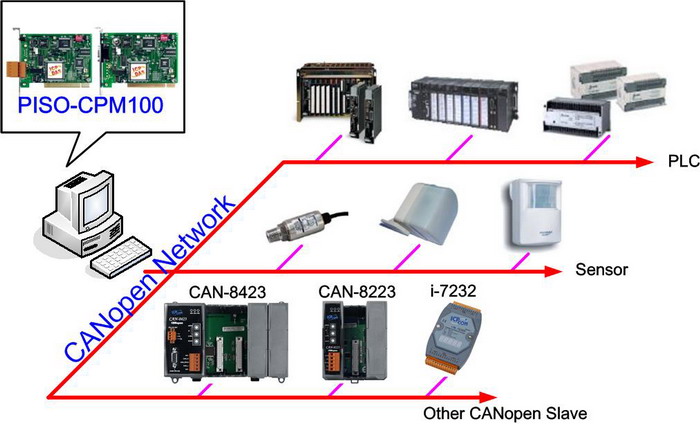
The PISO-CPM100 gives a very powerful and economic solution of an active CANopen master device with one CAN channel. It uses the NXP SJA1000T and 82C250 to be the CAN controller and transceiver, which provide bus arbitration, error detection with auto correction and re-transmission function. The 16-bit on-board microcontroller with real-time O.S., MiniOS7, allows many features, such as real-time message transmission and reception, filtering, preprocessing, and storage of CAN messages. Under the effect of the powerful microcontroller, this card can be made for one CAN controller manager without losing data, even in systems with a high PCI bus load. Therefore, the CANopen critical process can be implemented directly by CANopen firmware in the PISO-CPM100. In addition, users can develop their CANopen application by using the CANopen library on the host computer. When the PISO-CPM100 is active, the data exchange between users’ application and CANopen firmware is performed via the memory mapping method of the PISO-CPM100.
Applications
Features
- One CANopen slave communication port
- Standard CANopen specification DS-301 v4.02
- Support node id 1~127
- Programmable bauds: 10k, 20k, 50k, 125k, 250k 500k, 800k, and 1M bps
- Support both Node Guarding Protocol and Heartbeat Consumer Protocol
- Provide event trigger function for EMCY event, Node Guarding event and Heartbeat event
- Provide Event-trigged, remote-requested, cyclic and acyclic SYNC of PDO mode
- The PDO communication supports single byte output so that users can just modify the value of one byte without changing the others
- Allow dynamic PDO mapping
- The SDO communication support segment protocol
- Programmable slave node ID for the CANopen slave function
- Provide eVC++, VB.Net and C# demos
- Support WP-8xx1, VP-25W1 and XP-8xx1-CE6 PACs
- 256 records CANopen message receive buffer size
- 2500 Vrms photo-isolation protection on CAN side
- 3 indication LEDs (PWR, Rx/Tx, ERR LEDs)
Software Utility Features
- Utility tool for downloading user-defined firmware and updating default firmware
- Development Toolkit for eVC++, VS 2005 (VB.Net, C#.Net) on WinPAC
- Development Toolkit for C/C++ on MiniOS7
- I-8123W-CPS don’t support any ISaGRAF series main control unit
Hardware Specifications
| Hardware | |
| CPU | 80186, 80 MHz or compatible |
| SRAM/Flash/EEPROM | 512 KB / 512 KB / 16 KB |
| NVRAM | 31 bytes (battery backup, data valid for up to 10 years) |
| Watchdog | CPU built-in |
| RTC(Real Time Clock) | Yes |
| CAN Interface | |
| Controller | NXP SJA1000T with 16 MHz clock |
| Transceiver | NXP 82C250 |
| Channel Number | 1 |
| Connector | 5-pin screwed terminal block (CAN_GND, CAN_L, CAN_H, N/A for others) |
| Baud Rate (bps) | 10 k, 20 k, 50 k, 125 k, 250 k, 500 k, 800 k, 1 M |
| Transmission Distance(m) | Depend on baud rate (for example, max. 1000 m at 50 kbps ) |
| Isolation | 3000 VDC for DC-to-DC, 2500 Vrms for photo-couple |
| Terminator Resistor | Switch for 120Ω terminator resistor |
| Specification | ISO-11898-2, CAN 2.0A |
| Protocol | CANopen CiA DS-301 v4.02 |
| LED | |
| Round LED | PWR LED, Rx/Tx LED, ERR LED |
| Software | |
| Driver | WinPAC, ViewPAC, XPAC-CE6 (The XPAC series PAC only support one I-8123W-CPS) |
| Library | eVC++ 4.0, C#.net 2005, VB.net 2005 |
| Power | |
| Power supply | Unregulated +10 ~ +30 VDC |
| Protection | Power reverse polarity protection, Over-voltage brown-out protection |
| Power Consumption | 2W |
| Mechanism | |
| Dimensions | 31mm x 115mm x 91mm (W x L x H) |
| Environment | |
| Operating Temp. | -25 ~ 75 ℃ |
| Storage Temp. | -40 ~ 80 ℃ |
| Humidity | 5 ~ 95% RH, non-condensing |
Ordering Infomation
|
I-8123W-CPS-G CR
|
1 Port high performance CANopen slave module |
Related Products
| CA-0910-C | 9-pin Female D-sub & 3-wire CAN bus cable (1M) |
| SG-770 | 7/14 channel Surge Protector |
| 4PCD-002 | EMI Ferrite Split/Snap-On Core |
| M12A-5P-IP68 | Field-Installation A-coded 5-pin Female |