
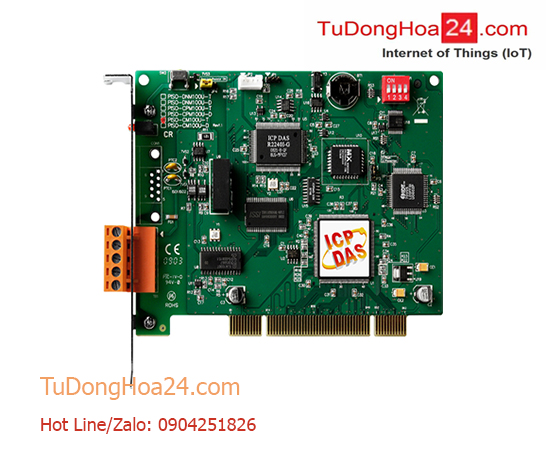
Card PCI 1 cổng CAN ICP DAS PISO-CM100U-T
The CAN (Controller Area Network) is a serial communication protocol, and efficiently supports distributed real-time control with a very high level of security. It is an especially suited for networking “intelligent” devices as well as sensors and actuators within a system or sub-system. In CAN networks, there is no addressing of subscribers or stations in the conventional sense, but instead prioritized messages are transmitted.
ICP DAS provides an open architecture platform for CAN bus PISO-CM100/100U. The PISO-CM100/100U represents a very powerful and economic solution of an active CAN board with one CAN channels, covering a wide range of CAN applications. The 16-bit on-board microcontroller allows, among many other features, the filtering, preprocessing, and storage (with timestamp) of CAN messages as well as the real-time transmission of CAN messages. PISO-CM100/100U also uses the new Phillips SJA1000T and Transceiver 82C250/251, which provide bus arbitration and error detection with auto correction and re-transmission function. Under the effect of the powerful microcontroller, this card can be made for one CAN controller without losing data, even in systems with a high bus load. Besides, equipped with integrated intelligence functions, the PISO-CM100/100U makes it is possible to preprocess CAN data streams, thus relieving the PC of a considerable burden. As a result, real-time requirements on the PC applications are drastically reduced. Due to the state-of-the-art, it can be installed in a slot of 32-bits PCI bus or Universal PCI bus and supported truly “Plug & play” technology.
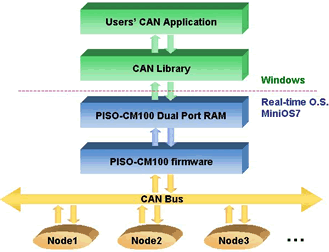
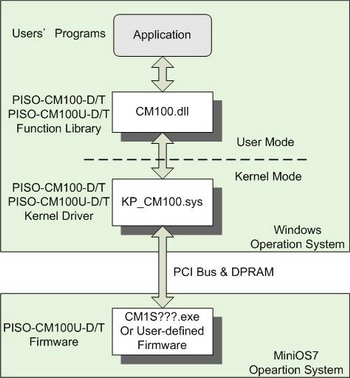
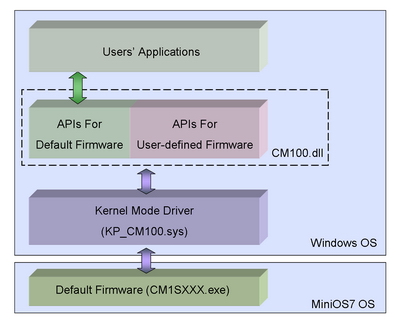
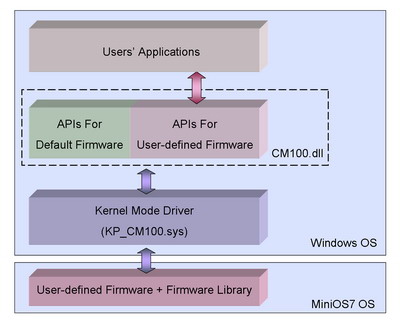
In addition, users can develop their own CAN application by using the PISO-CM100/100U library. When the PISO-CM100/100U is active, the data exchange between users’ application and can bus firmware is performed via the memory mapping method of the PISO-CM100/100U.
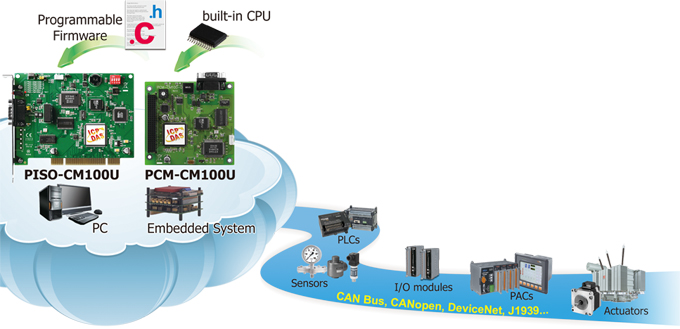
Application
 |
|
 |
Concrete Station Monitor & Control System (Traditional Chinese) |
Features
-
Microprocessor inside with 80186, 80MHz
-
82C250 CAN transceiver
-
SJA1000T CAN controller
-
Support both CAN 2.0A and CAN 2.0B
-
Timestamp with at least ±1ms precision
-
DIP switch to select board number
-
Dual port RAM communication mechanism
-
RTC (real time clock) inside
Hardware Achitechture

Software Achitecture
|
CAN bus Features:
|
|
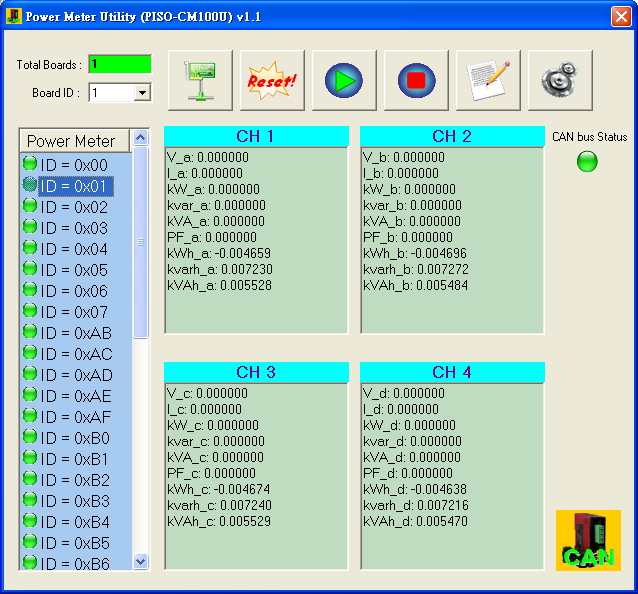
Link to Power Meter page… |
 |

OS:Windows XP SP 3
CPU:Intel Core 2 Duo 2.00 GHz
RAM:512 MB
|
Baud Rate(bps)
|
CAN 2.0 A
|
CAN 2.0 B
|
|
Frame per sec.
|
Frame per sec.
|
|
|
1000 k
|
7502
|
6589
|
|
800 k
|
6188
|
5258
|
|
500 k
|
4097
|
3451
|
|
250 k
|
2140
|
1801
|
|
125 k
|
1098
|
920
|
|
50 k
|
440
|
371
|
|
20 k
|
176
|
148
|
|
10 k
|
88
|
74
|
Windows Drivers:
- Development Toolkit for Windows 2000/XP/7(32-bit/64/bit OS)
- Demos for VB 6.0, VC++ 6.0, BCB 6.0, Delphi 4.0
- Demos for C#
Windows Tools:
-
CANUility (Include send/receive CAN messages, message ID filter, data format transformation, messages recoder and firmware update functions)
-
Debug tool
MiniOS7 Tools:
-
C/C++ Library for RTC, EEPROM, LED, DPRAM, CAN controller and timers control functions
-
Demos for TC, TC++, BC and BC++
Hardware Specifications
|
Model Name
|
PISO-CM100U-D
|
PISO-CM100U-T
|
|
Hardware
|
||
|
CPU
|
80186, 80 MHz or compatible
|
|
|
SRAM/Flash/EEPROM
|
512 KB / 512 KB / 16 KB
|
|
|
DPRAM
|
8 KB
|
|
|
NVRAM
|
31 bytes (battery backup, data valid for up to 10 years)
|
|
|
RTC (Real Time Clock)
|
Yes
|
|
|
Bus Interface
|
||
|
Type
|
Universal PCI, 3.3 V and 5 V, 33 MHz, 32-bit, plug and play
|
|
|
Board No.
|
By DIP switch
|
|
|
CAN Interface
|
||
|
Controller
|
NXP SJA1000T with 16 MHz clock
|
|
|
Transceiver
|
NXP 82C250
|
|
|
Channel number
|
1
|
|
|
Connector
|
9-pin male D-Sub
|
5-pin screwed terminal block
|
|
Baud Rate (bps)
|
10 k, 20 k, 50 k, 125 k, 250 k, 500 k, 800 k, 1 M (allow user-defined baud rate)
|
|
|
Isolation
|
3000 VDC for DC-to-DC, 2500 Vrms for photo-couple
|
|
|
Terminator Resistor
|
Jumper for 120 Ω terminator resistor
|
|
|
LED
|
||
|
Round LED
|
Rx/Tx LED, ERR LED
|
|
|
Power
|
||
|
Power Consumption
|
300 mA @ 5 V
|
|
|
Software
|
||
|
Driver
|
Windows XP/7/8/10 (32-bit/64-bit OS), InduSoft
|
|
|
Library
|
VB 6.0, VC++ 6.0, BCB 6.0, Delphi 4.0, C# 2008
|
|
|
Mechanism
|
||
|
Dimensions
|
138mm x 22mm x 105mm (W x L x H)
|
|
|
Environment
|
||
|
Operating Temp.
|
0 ~ 60 ℃
|
|
|
Storage Temp.
|
-20 ~ 70 ℃
|
|
|
Humidity
|
5 ~ 85% RH, non-condensing
|
|
Ordering Informations
| PISO-CM100U-D | Intelligent CAN interface with one Isolated Protection CAN Communication Port and 9-Pin D-sub connector for Universal PCI bus systems |
| PISO-CM100U-T | Intelligent CAN interface with one Isolated Protection CAN Communication Port and 5-Pin Screw Terminal Connector for Universal PCI bus systems |
Optinal Accessories
| CNT-CAN | CAN bus Connector |
| CA-0910-C | 9-pin Female D-sub & 3-wire CAN bus cable (1M) |
| SG-770 | 7/14 channel Surge Protector |
| 4PCD-002 | EMI Ferrite Split/Snap-On Core |
| M12A-5P-IP68 | Field-Installation A-coded 5-pin Female |