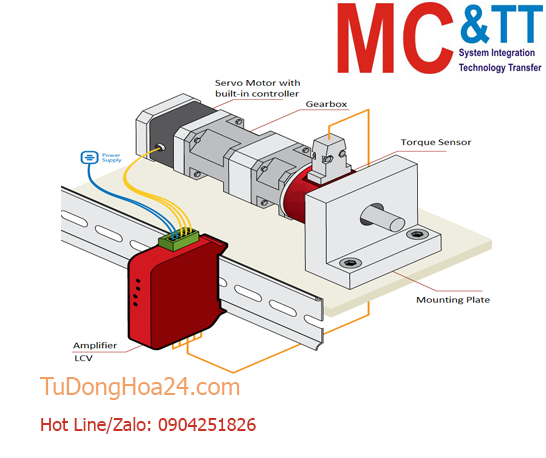
Ứng dụng cảm biến Momen Xoắn trong Vệ tinh (Satellite Reaction Wheel Torque)
One of the more efficient means of satellite attitude control is using reaction wheels. Reaction wheels scale easily making them excellent candidates for attitude control systems in a CubeSat. They create small torque changes necessary to keep a communication antenna pointing at earth or a telescope pointing at a star. By utilizing a micro torque sensor, the response time and torque output of the motor/flywheel can be measured, allowing for precision control loop gains to be established for the PID balancing functions used to stabilize the spacecraft.
-
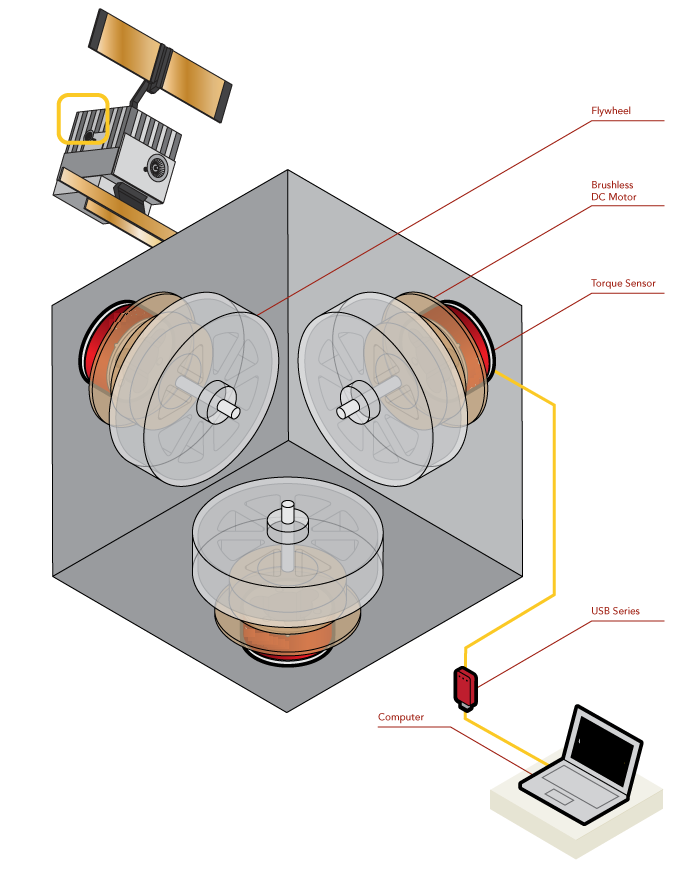
As an electric motor spins a flywheel, the torque generated is used to provide attitude stabilization about the axis the motor is mounted on.
- The Reaction Torque Sensor is mounted between a brushless DC motor and the wall of the satellite.
- As the electric motor spins the flywheel up to the commanded rotational velocity, the resulting torque is reported by the Torque Sensor.
- The torque generated is used to provide attitude stabilization about the axis the motor is mounted on.
-
The measured torque is then displayed and recorded with the LCV-USB3 via Lorenz software.